Market Morsel: Why it’s important to understand the true value of our grain.
Market Morsel
The term basis is one of the most commonly used — and often misunderstood — concepts in grain markets. In simple terms, basis is the difference between the local physical grain price and the futures market price.
When a farmer receives a flat price from a grain buyer, that number already combines several elements: the global futures price, currency movements and basis. Basis is therefore the local market adjustment added to international pricing.
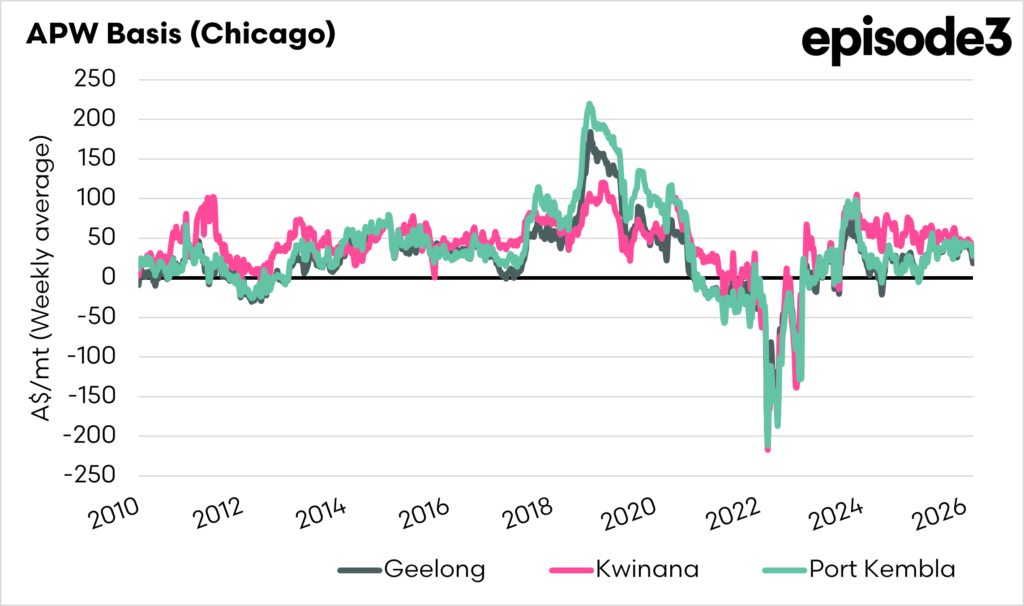
In Australia, wheat basis is typically measured against Chicago Board of Trade wheat futures converted into Australian dollars. Basis can be either positive, meaning local prices trade at a premium to futures, or negative, meaning they sit at a discount. Historically, Australian wheat basis has often traded at a premium, reflecting regional supply conditions and export demand.
The biggest driver of basis is local supply. When production is tight, such as during drought years, domestic consumers and exporters compete more aggressively for limited grain supplies. This competition pushes basis higher as buyers attempt to secure tonnes. In contrast, large harvests increase available grain and reduce buyers’ urgency, causing basis levels to weaken.
Recent Australian seasons provide clear examples of this cycle. Drought years saw basis rise to exceptionally strong premiums as grain became scarce. This was followed by several large crops, which saw basis fall as surplus production reduced competition for supply. At present, basis levels are sitting at average levels, signifying no major oversupply or undersupply issues in Australia.
Importantly, basis reflects local market conditions rather than global price direction. A strong basis does not necessarily mean farmers are better off overall. High premiums often occur when production volumes are low, limiting total sales. Conversely, weaker basis levels frequently coincide with large crops, where lower premiums may still deliver stronger overall farm income through higher production.
Understanding the basis is also useful for grain marketing decisions. Many pricing strategies separate futures and basis exposure, allowing growers to manage global price risk independently from local supply dynamics.
Ultimately, the basis is the mechanism that links global grain markets to local realities. Futures markets establish the international benchmark, while basis determines what grain is worth at a specific place and time, shaped largely by supply, demand and seasonal production outcomes.