
Fuel Relief or Fuel Risk?

The Snapshot
- Cutting fuel excise should lower prices, but behaviour may override policy in the short term
- Lower prices can pull demand forward and remove the normal brake on consumption
- Easter travel demand risks stacking on top of panic buying behaviour
- Farmers are not hoarding fuel; they are using it as an essential input to produce
- The real risk is a behaviour driven tightening before any price relief flows through
The Detail
Fuel prices should fall if the excise is removed, but there is a real risk that the opposite happens first, and by more than expected.
On paper, cutting fuel excise takes around 26 cents per litre out of the price. In a stable market, that flows through cleanly and provides immediate relief. This is not a stable market, and this is not a normal price signal.
Right now, the fuel system is already tight. Australia imports most of its refined fuel and relies on a just-in-time supply chain that depends on steady shipping flows and predictable demand. When either of those breaks, the system does not adjust smoothly; it tightens quickly.
The key issue is not just supply, it is behaviour. High prices normally perform an essential function in markets like fuel. They ration demand. They force consumers and businesses to make decisions about what not to do. Trips get delayed. Tanks are not topped up unnecessarily. Marginal demand disappears. That is demand destruction, and it is what stabilises a tight system.
A sudden drop in price has the opposite effect. It removes that discipline instantly.
When the price falls sharply, even if only due to tax, the signal to the market changes. Consumers do not just continue as normal; they respond. They fill up earlier than needed. They top off tanks that are already half full. Some look to store fuel where possible. Businesses bring forward orders.
That is not new demand, but it behaves like it. It is demand-pulled forward and concentrated over a short period. In a system with limited flexibility, that matters.
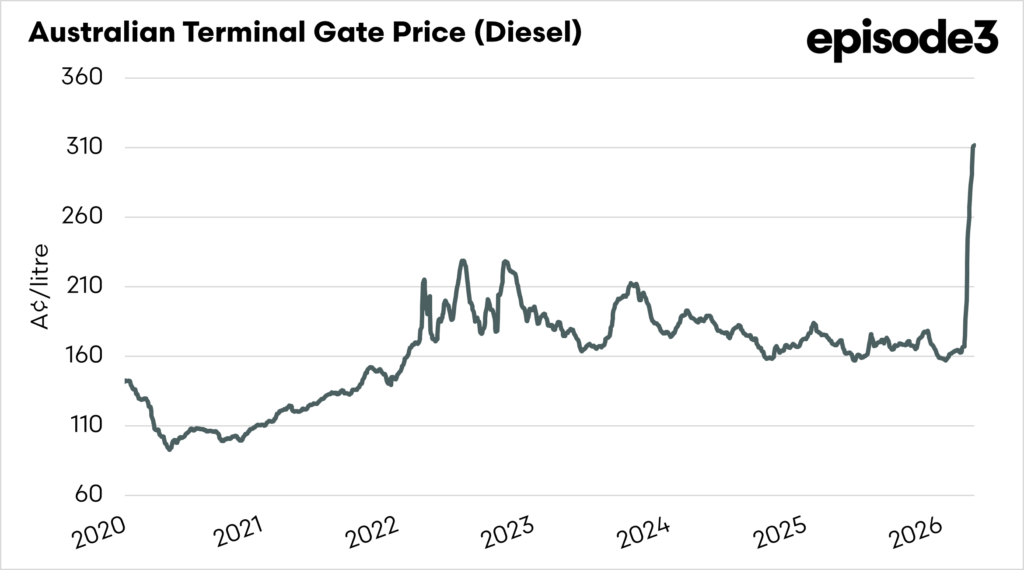
Instead of a smooth reduction in price, the market can be pushed into a demand spike. That spike tightens supply at the exact moment the policy is trying to ease pressure. The result is a feedback loop. Lower prices trigger buying. Buying creates the perception of shortage. Shortage supports higher prices. Higher prices validate the original behaviour.
The uncomfortable reality is that the increase in demand can exceed the tax savings themselves. If enough demand is brought forward in a short window, wholesale and retail prices can lift by more than the value of the excise cut. In effect, a policy designed to lower prices risks creating the conditions for them to rise.
The lead up to Easter is one of the largest travel periods of the year. Fuel demand naturally increases as people move across the country. Those trips are often locked in and difficult to change. Under normal conditions, high prices would temper that demand at the margin. Some trips would be shortened, delayed or reconsidered. That is how the system balances. Lower the price ahead of that window, and that balancing mechanism weakens.
Instead of demand being rationed, it is maintained or even increased. Panic buying risk sits atop seasonal travel demand, both layered onto a supply chain that is already tight. That combination can make the market feel significantly tighter than the underlying supply would suggest.
Distribution then amplifies the issue. Even if there is enough fuel in the country overall, moving it fast enough to meet a sudden surge in demand is difficult. Local shortages can emerge. Empty service stations send a stronger signal than any policy announcement, and that signal spreads quickly through behaviour.
Farmers are not panic-buying fuel. Fuel on the farm is a working input tied directly to production. It is linked to seeding programs, spraying windows and the timing of operations. If fuel is unavailable when required, production is immediately impacted. That demand is inelastic and unavoidable.
On farm storage is standard practice and reflects logistics, not speculation. An increase in fuel use at this time of year is operational, not behavioural.
The pressure comes when that essential demand intersects with behaviour driven demand from consumers. One cannot adjust. The other accelerates. The system tightens quickly as a result.
In the short term, this creates a clear risk. Prices may not fall as expected. In some cases, they may rise despite the excise cut. Localised shortages could emerge even if the overall supply is sufficient. Volatility increases rather than declines.
In the medium term, once behaviour settles and demand normalises, the excise cut should begin to flow through more clearly. But getting there may not be smooth, and the path matters as much as the destination.
The key point is this. Fuel markets are not just driven by policy or supply. They are driven by how people respond to price signals.
Lowering the price is meant to bring relief. Under the wrong conditions, which we are in, it can remove the very mechanism that keeps demand in check and, in doing so, push the market in the opposite direction.