
The End of Sheep Live Export: Canberra Killed It. The War Buried It.
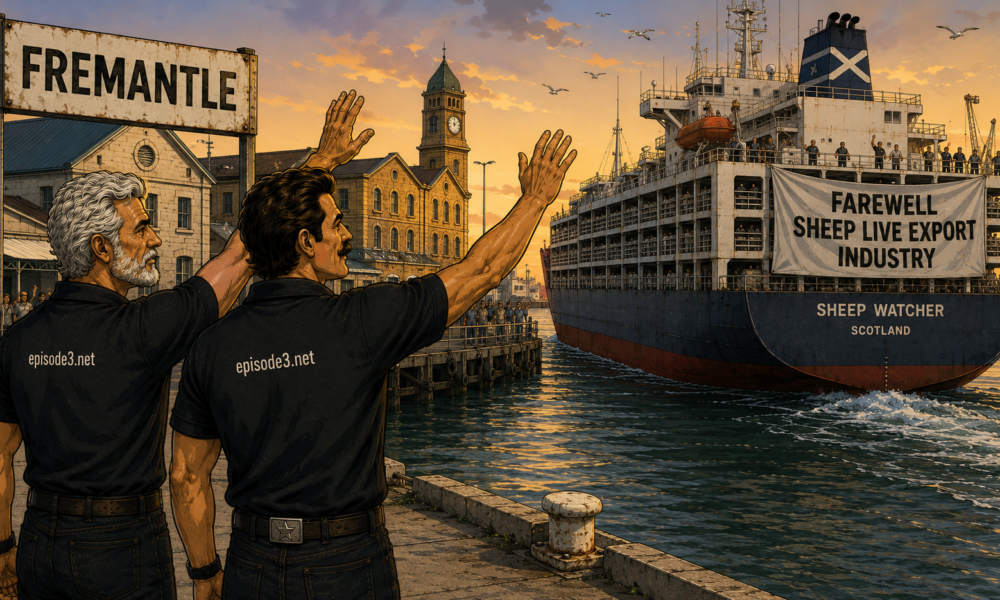
Australia’s live sheep export trade may not officially end until 2028, but looking at the latest export figures, the industry’s final years are now coming into sharper focus.
The trade has survived decades of political fights, farmer protests, and volatile Middle Eastern markets. It leaves behind generations of Western Australian producers who built businesses around supplying sheep into a trade that once exported millions of head annually and formed a critical part of the state’s sheep industry.
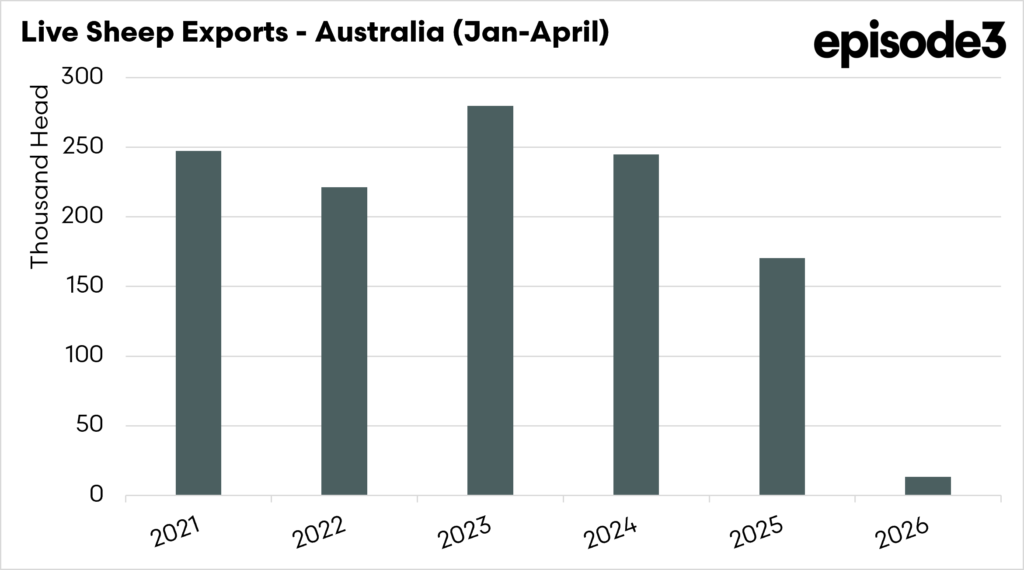
Its decline had been slow for years. In 2021, Australia exported 552,957 live sheep. By 2025, that number had fallen to 318,820 head. In the first four months of 2026, with only one vessel loaded, exports totalled just 13,282 sheep. This is 5% of the average for the first four months of the year.
The annual northern-hemisphere summer moratorium now looms, meaning there will effectively be no further shipments until September due to heat-stress restrictions during the Middle Eastern summer. Unless there is a strong rebound in activity later this year, 2026 is shaping up as potentially the smallest live sheep export year in modern Australian history.
Officially, the cause of decline will likely be recorded as government policy.
Once the Albanese Government legislated the phase out of live sheep exports by sea, the commercial reality of the industry changed at once. Investment slowed, confidence weakened, and the long-term viability of the supply chain came into question. Industries rarely thrive once governments signal that they have no long-term future.
But while the phase-out may have set the industry on its current path, the war in Iran appears to have dramatically accelerated the timeline.
For an industry dependent on stable access into the Middle East, the conflict involving Iran struck at the worst possible moment. As tensions escalated around the Strait of Hormuz, the economics of operating vessels into the region deteriorated rapidly. Shipping risk increased sharply, insurance premiums surged, freight costs climbed, and vessel scheduling became increasingly unpredictable.
The trade was already weakened. The conflict exposed how little resilience remained.
There is an uncomfortable irony buried in all of this for Australian agriculture. Many rural Australians who strongly support Donald Trump often view conflicts in the Middle East as distant geopolitical events with little bearing on day-to-day farming operations. Yet the fallout from the Iran conflict has flowed directly back into Australian farmgate margins. Grain producers are now dealing with higher fuel and fertiliser costs as shipping risk, energy markets and freight costs surge, while sheep producers are facing the reality that one of their most important export regions has effectively become partially closed or commercially impaired by the instability in the Gulf. What happens in Washington or Tehran no longer stays in Washington or Tehran. It increasingly shapes profitability in the paddock.
The live sheep trade became collateral damage in a much larger geopolitical fight.
Without the war, the industry likely would have continued declining gradually towards the 2028 phase-out date. There still may have been enough confidence and functionality left in the system for exporters to keep vessels moving at reduced levels. Instead, the combination of domestic political uncertainty and escalating instability in the Gulf appears to have compressed several years of decline into a much shorter period.
Like many agricultural industries before it, the live sheep trade was ultimately vulnerable not just to local politics, but to global forces far beyond the farm gate. Canberra put the trade on borrowed time. Washington and Tehran shortened the clock.
For Western Australian sheep producers, the consequences will stretch beyond when the final vessel sails. Live export provided competition for processors, another pricing mechanism for producers and an outlet for specific classes of sheep. Once supply chains disappear, they are rarely rebuilt. Ships move elsewhere, importers establish alternative relationships, and infrastructure slowly fades away.
The industry didn’t die. It was killed, first by Canberra, then by a war on the other side of the world.