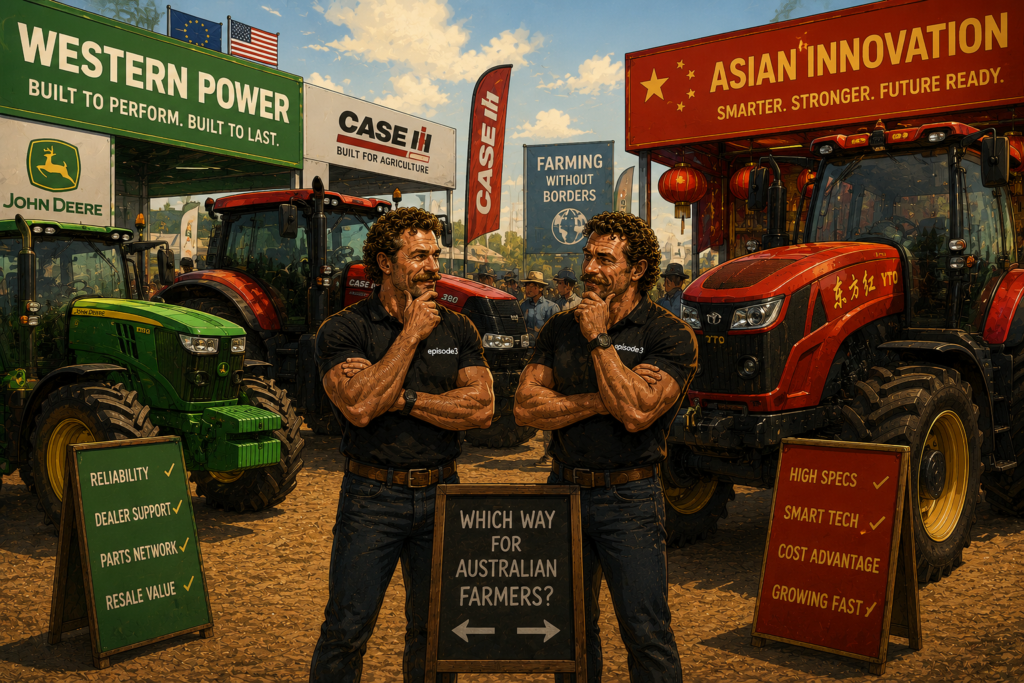
Could Asian machinery do to tractors what it did to cars?
This article was originally featured in the ACM Mastheads during May (read here).
Australian farmers trust their machinery brands. They’ve earned that trust over decades. But standing in a convention centre in Bangkok last week, watching manufacturer after manufacturer show serious, well-finished equipment, we kept asking ourselves the same thing: are Asian machinery brands about to do to the tractor market what they’ve already done to the car market?
The Episode 3 team were in Bangkok in May for Agritechnica Asia. There were some familiar colours of machinery. The big global brands that have dominated Australian machinery sheds for decades, and for good reason. Scale, reliability, dealer networks, and long histories in the paddock.
But alongside them, filling stand after stand, were manufacturers from China, Thailand, India, Korea and elsewhere that most Australian farmers would struggle to name. They weren’t fringe exhibitors and were showing serious, well-finished equipment with clear commercial intent.
The question isn’t really whether you’d buy something cheaper. The harder question is what it would take for you to trust a brand you’d never heard of.
For most Australian growers, the honest answer is probably: a lot. And that’s fair. Farm machinery isn’t bought the way you buy a phone. A tractor or harvester must work when the season demands it, not when it’s convenient. A breakdown at sowing or harvest isn’t just an inconvenience.
Not everything we saw was relevant to Australian conditions, as the conference focused heavily on Asian producers. A lot of it was designed for smaller-scale Asian farms, rice production, tropical systems. Some of that kit isn’t going anywhere near a broadacre paddock in the wheatbelt.
That doesn’t mean the machinery should be dismissed instantly. We think Australian farmers are better served by taking the longer view. These manufacturers aren’t standing still. Across drones, irrigation, sensors, robotics, small tractors and post-harvest technology, there were companies showing genuine capability, not just cheap imitations of Western equipment.
The car comparison is obvious. Ten years ago, MG and BYD were unknowns. Today, they’re selling serious volume in Australia because they came in with competitive pricing, reasonable quality, and critically, they backed it up. Farmers are sceptical people by nature, but they’re not irrational. If something works and someone stands behind it, attitudes shift.
The difference, of course, is that a car can sit at the dealership for a week. A machine you need at harvest or seeding can’t. That’s where Asian machinery brands will need to do real work if they want a foothold here, with parts availability and servicing being as important as purchase price
Already, smaller properties and lifestyle farms are an ideal target market for cheaper, lower-powered tractors from Asian manufacturers, and sales are quietly increasing. The price point is attractive, the use case is simple, and the consequences of a bad experience are manageable. But the next jump, from the small stuff to large-capacity commercial farming equipment, is a much bigger leap. It will require these brands to solve the parts, service, and support problem first, and that’s much harder to build than the machinery itself. It will also require Australian farmers to see it proven under local conditions, on broadacre country, through a full season, before they seriously consider it for their own operation. That proof is still a few seasons away at best, and probably longer.
The established brands aren’t going anywhere. Their dealer networks and accumulated trust aren’t easily replicated. The choice, though, is set to widen, and some growers, particularly those feeling the squeeze of higher costs across the board, will start paying more attention to names they once would have ignored.
You only have to look at the rise of brands such as BYD, MG, GWM and Chery to see how quickly perceptions can change when price, quality and support start to line up. Chinese car brands have gone from curiosity to serious volume players in Australia in a relatively short period.
Farm machinery is a different proposition, with higher risk, tighter seasonal windows and far greater reliance on local service support. But as machinery prices continue to rise, the willingness to consider new names may grow. Asian manufacturers do not need to replace the established brands to change the market. They only need to become credible enough that farmers start asking the question.