
Sheepmeat export update July 2026
July 2026 - Sheep Meat Export Update
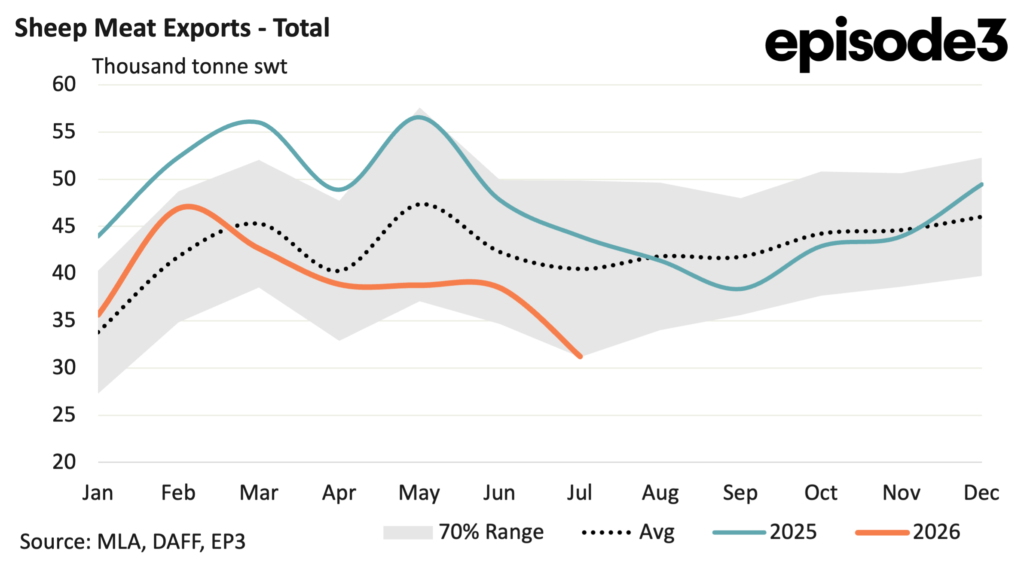
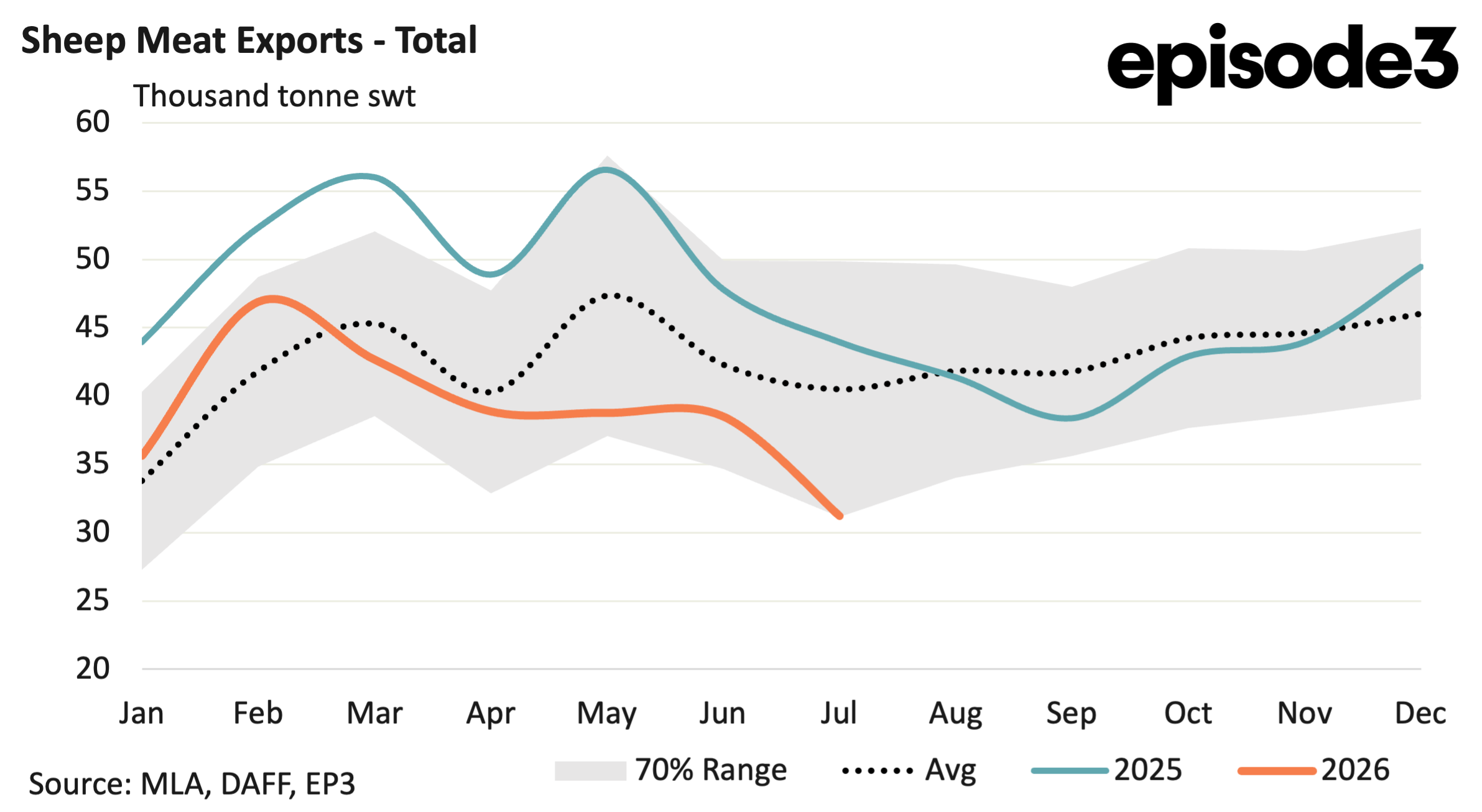
Australian sheep meat exports fell sharply during July 2026, with combined lamb and mutton shipments reaching 31,217 tonnes shipped weight. That was 29 percent below July last year and 23pc under the five-year average for the month, making July one of the weaker export performances recorded so far in 2026. The result reflects a broader tightening in available sheepmeat supply, with high livestock prices and reduced slaughter volumes limiting the amount of product available for export. Demand conditions also remained uneven across several important markets, particularly within the Middle East and North Africa region. While there were signs of improvement in selected destinations, the recovery remained fragmented and insufficient to offset weaker flows elsewhere.
China retained its position as Australia’s largest sheep meat destination during July, taking 7,003 tonnes. Shipments were 35pc lower than July last year and 24pc below the five-year average. The decline continued the softer pattern evident through much of 2026.
China remains the largest single destination in cumulative terms, accounting for 21.8pc of Australian sheepmeat exports so far this year, but monthly demand has been noticeably weaker than the elevated levels recorded in 2025. China continues to provide an important volume outlet, particularly for lower-value lamb and mutton products, but it has not offered the same level of support seen during stronger phases of the trade.
July’s result indicates that Chinese buying remains cautious, with softer import demand adding to the pressure created by reduced Australian supply.
The United States received 6,512 tonnes during July. Exports were 5pc below the same month last year and 17pc below the five-year average. Although the US result was weaker than normal, the market remained comparatively resilient. The United States continues to account for 19.8pc of Australian sheep meat exports in 2026 and remains the second-largest destination behind China. US demand has been one of the more dependable features of the sheep meat trade over recent years, particularly for higher-value lamb cuts. July’s decline suggests even this market was unable to fully absorb the impact of tighter Australian supplies and higher prices, but the year-on-year fall was considerably smaller than that recorded across China or the broader group of destinations.
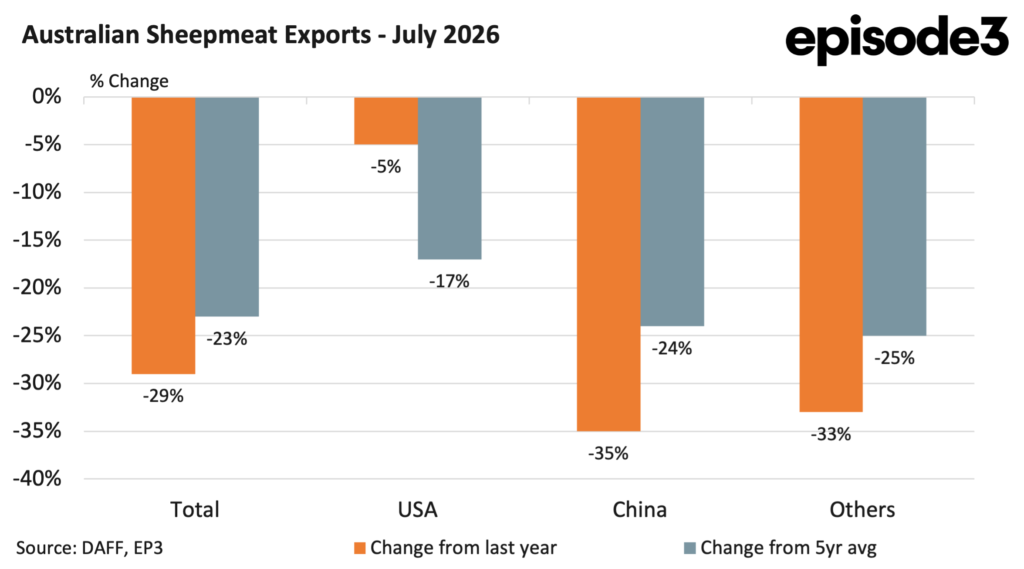
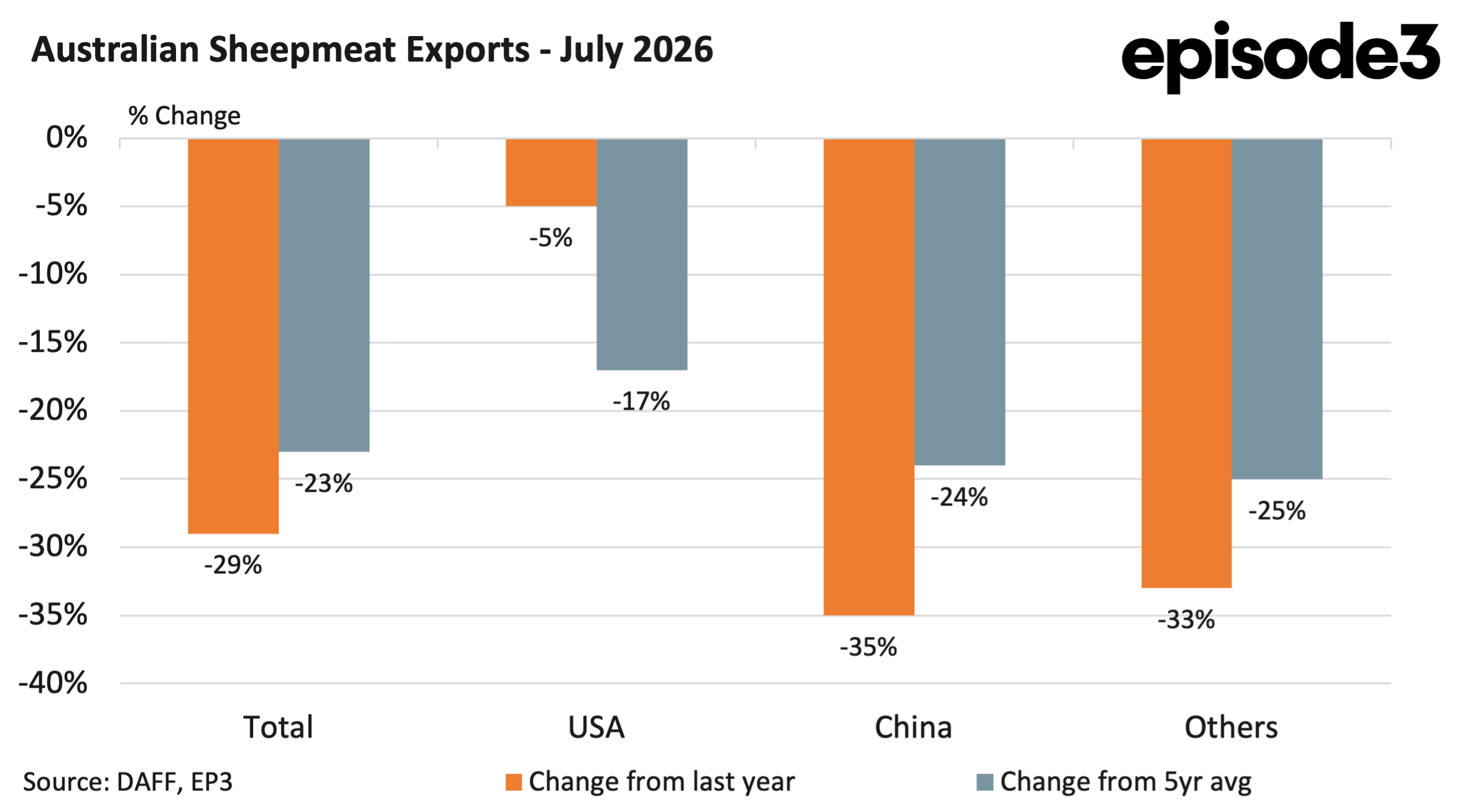
Exports to all other markets combined reached 17,702 tonnes during July. That was 33pc below last year and 25pc below the five-year average. This category includes the MENA region, other Asian markets and a wide range of smaller destinations. The scale of the decline shows that the weakness was not confined to one market. Instead, reduced flows were spread across several regions, with the Middle East continuing to produce mixed results.
The lamb trade into the MENA region showed some signs of improvement during July. Exports to the United Arab Emirates were only 8pc below the five-year average, a much smaller deficit than seen earlier in the year. Jordan stood out as the strongest lamb market, with shipments 37pc above the five-year average. Qatar remained weaker, with lamb flows 21pc below average, while Bahrain was 54pc under normal July levels.
Bahrain had shown a sharp rebound during June after several months of minimal trade, but July’s decline indicates that recovery has yet to become consistent.
Mutton flows across the region were similarly uneven. Exports to Saudi Arabia were 61pc below the five-year average, making it the weakest of the major MENA mutton destinations during the month. UAE mutton flows were 8pc below average, while Kuwait was 31pc lower. Oman provided the main positive result, with mutton exports running 19pc above the five-year average. This reinforces the point that demand across the MENA region is not moving in a uniform direction. Some markets are gradually recovering, while others remain well below historical trade levels.Looking across the first seven months of 2026, Australia’s sheepmeat export portfolio remains broadly diversified.
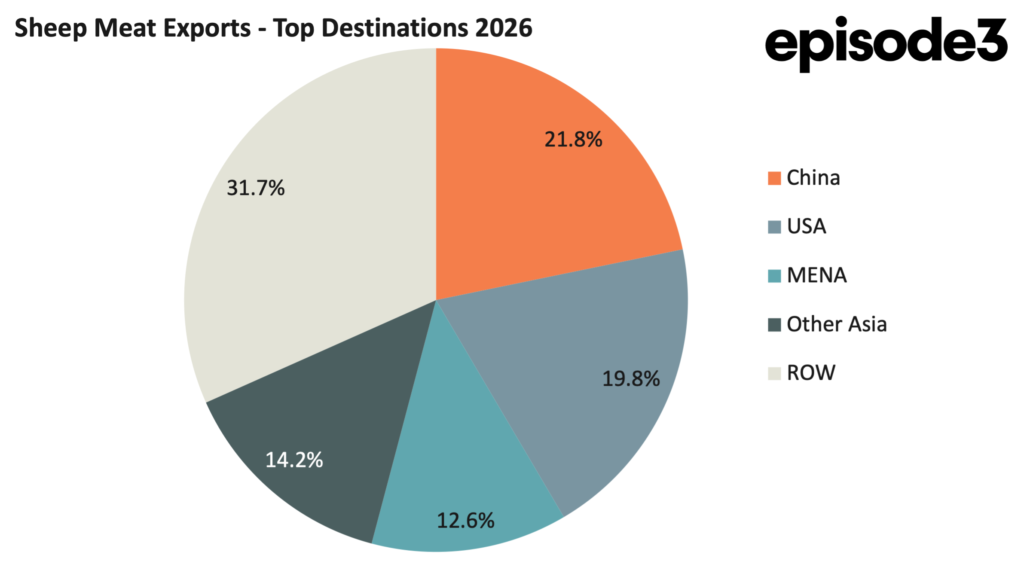
Looking across the first seven months of 2026, Australia’s sheepmeat export portfolio remains broadly diversified. China accounts for 21.8pc of total exports, followed by the United States at 19.8pc. The MENA region holds a 12.6pc share, other Asian markets account for 14.2pc and the rest of the world represents 31.7pc. That diversification remains a strength, but July also demonstrates its limits. When several regions soften at the same time, there are fewer opportunities to redirect product and maintain total volumes.
Unlike the beef trade, where weakness in China has been offset by very strong demand from the US, South Korea and Japan, sheepmeat exports are currently facing softer flows across a wider range of destinations. The July result therefore appears to be driven by both supply and market factors.
Australian lamb and mutton prices remain historically high, reflecting reduced livestock availability and strong competition between processors.
Those conditions support producer returns but constrain export throughput and can make Australian product more difficult to place in price-sensitive markets.