
Weak processor activity takes the heat out prices
Market Morsel
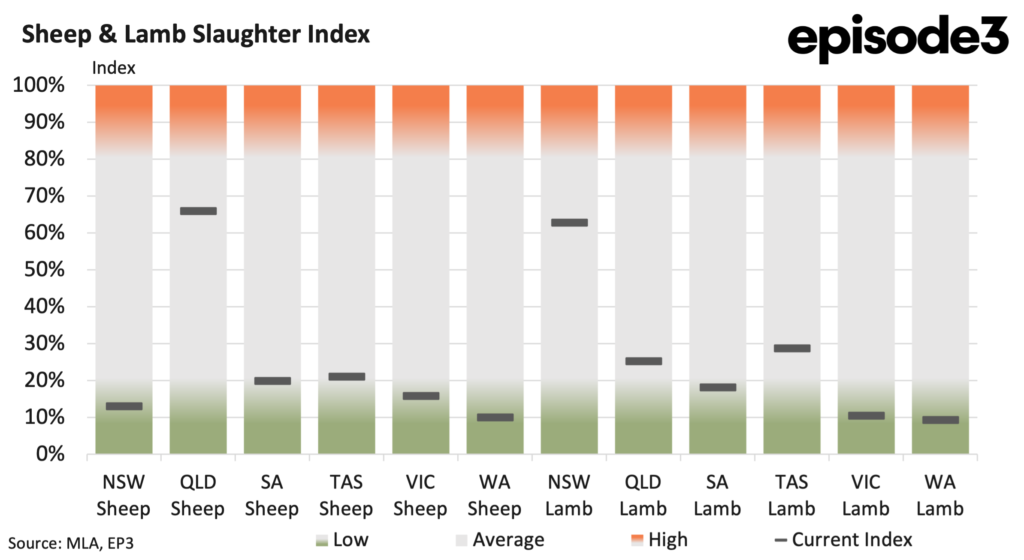
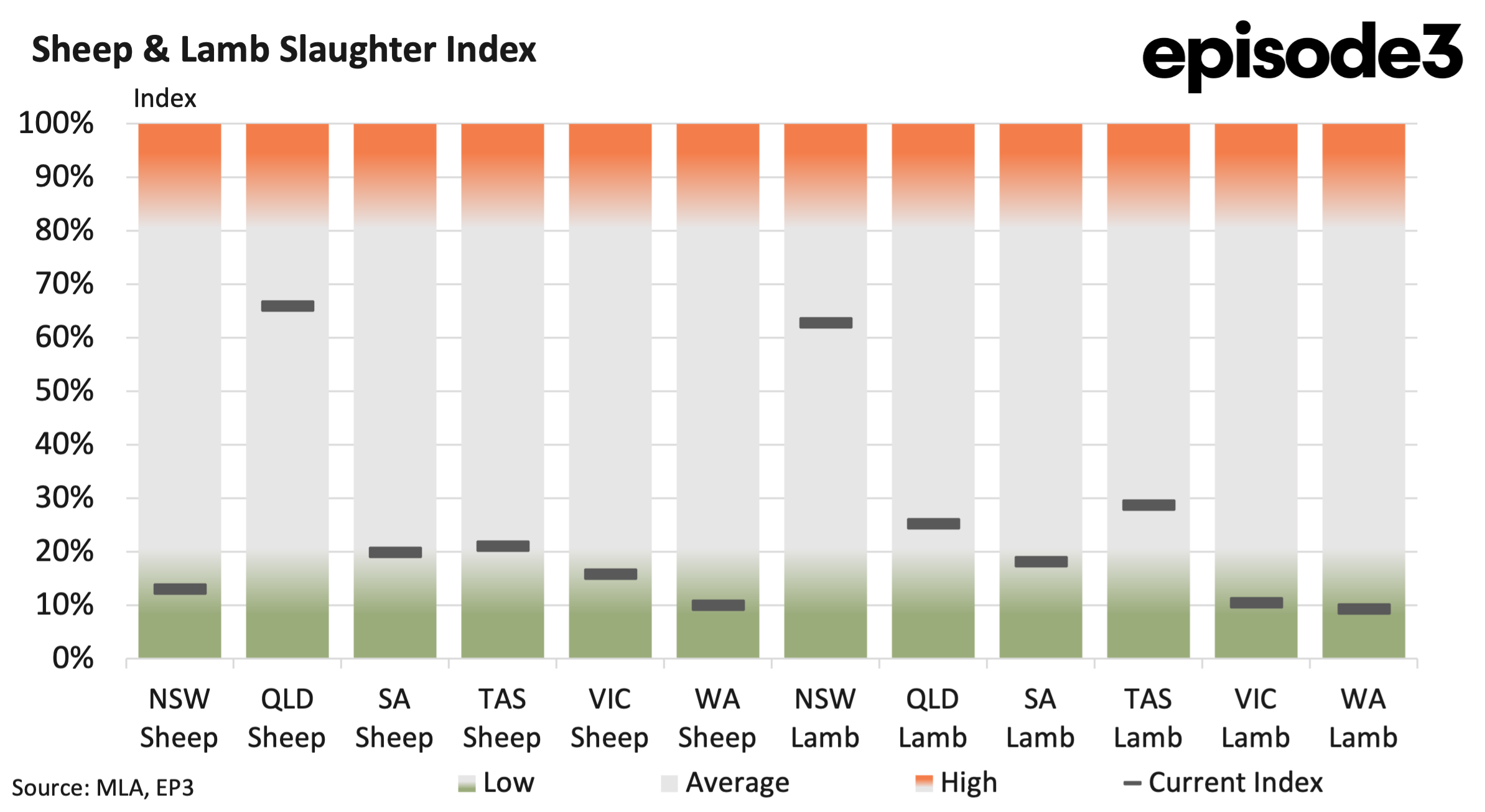
The latest Sheep and Lamb Slaughter Index shows some improvement in livestock availability through the mid-July to mid-August period, but the change is far from uniform across the country. The clearest improvement has occurred in New South Wales and Queensland, particularly for lamb, while several southern markets remain firmly in winter tightening mode.
For sheep, index levels increased across five of the six states, although most of these gains came from historically low levels. New South Wales sheep slaughter increased from 8pc in the June to July period to 13pc in July to August. Queensland recorded the largest improvement, rising from 39pc to 66pc, while South Australia increased from 13pc to 20pc. Victoria lifted from an extremely low 5pc to 16pc and Western Australia edged higher from 7pc to 10pc. Tasmania was the exception, with sheep slaughter falling from 31pc to 21pc. The improvement suggests processors have been able to source more sheep than during the depths of the winter supply squeeze, but the index levels remain relatively low across much of southern Australia.
The lamb slaughter picture provides an even clearer example of the regional differences developing within the market. New South Wales lamb slaughter increased strongly from 41pc to 63pc, making it the standout lamb processing region during the latest period. Queensland also improved from just 9pc to 25pc, while Tasmania almost doubled from 15pc to 29pc. South Australia was broadly steady, edging from 20pc to 21pc. The southern markets were considerably tighter. Victorian lamb slaughter fell sharply from 27pc to 10pc, while Western Australia dropped from 17pc to just 9pc. The contrast suggests the national sheep meat market is undergoing a regional rebalancing rather than experiencing a broad-based increase in supply.
New South Wales is particularly interesting because the slaughter data is supported by the recent Sheep and Lamb Yarding Index. NSW lamb yardings increased from 19pc in the June to July period to 43pc during July to August, while sheep yardings rose from 23pc to 39pc. The combination of higher lamb yardings and lamb slaughter suggests that more stock is genuinely becoming available in NSW rather than processors simply shifting procurement between saleyards and direct channels. The lamb story is particularly clear, with increased saleyard offerings flowing through into substantially stronger processor throughput.
Sheep are slightly different. Despite NSW sheep yardings increasing to 39pc, the sheep slaughter index remains at just 13pc. Mutton and lamb reached historically strong levels during July, and processors had a significant incentive to reduce their activity during winter while offshore demand remained soft.
The price behaviour over the past four weeks also suggests that this has helped take some of the heat out of prices. Mutton has fallen by approximately 60c over four weeks to around 815c/kg cwt. Restocker lamb has recorded the largest correction, declining by around 87c to approximately 1,077c/kg cwt. Light lamb prices have fallen by about 100c, while Merino lamb is down around 81c. Heavy lamb has eased by approximately 25c and trade lamb has been comparatively resilient, falling by around 39c over the four-week period.
The broad decline in prices fits with the improvement in livestock availability across parts of the country, particularly NSW. However, it would be misleading to interpret the correction as evidence that Australia has suddenly moved into an oversupplied sheep meat market. Victoria and Western Australia remain extremely tight for lamb slaughter, while sheep processing levels remain low across several southern regions. Instead, the market appears to be moving away from the extreme scarcity conditions experienced earlier in winter. NSW is providing more lambs, and Queensland has also recorded an improvement in slaughter, giving processors greater access to stock than they had several weeks ago. That additional supply is arriving at a time when the demand side of the market is also providing less support.
Export conditions have remained relatively subdued, with weaker Chinese demand and disrupted access to some Middle Eastern markets limiting the ability of processors to pass historically high livestock prices through to overseas customers. Processors themselves have also been operating under extremely difficult trading conditions during 2026, increasing resistance to paying the exceptional livestock values reached during the winter rally.
Earlier in winter, livestock availability was sufficiently tight that processors had little choice but to compete aggressively for sheep and lambs That equation is now beginning to change as the reduced export demand means processors are not competing as hard for stock. The winter supply squeeze has therefore lost some of its intensity, but underlying livestock availability remains tight enough that the market is still some distance from being comfortably supplied.