
Australia is now a lentil powerhouse

The Snapshot
- Australian lentil production is forecast at 2.21Mt in 2026, up 482pc since 2010.
- Australia now produces around 88pc as many lentils as Canada, compared with just 19pc in 2010.
- Australia’s share of combined Australian and Canadian production has risen from 15.9pc to 46.9pc.
- Lentils trade in a relatively thin global market, so large Australian crops can have a meaningful impact on prices.
- Lentils still offer strong agronomic value, but growers need to think carefully about demand, competition and marketing as production expands.
The Detail
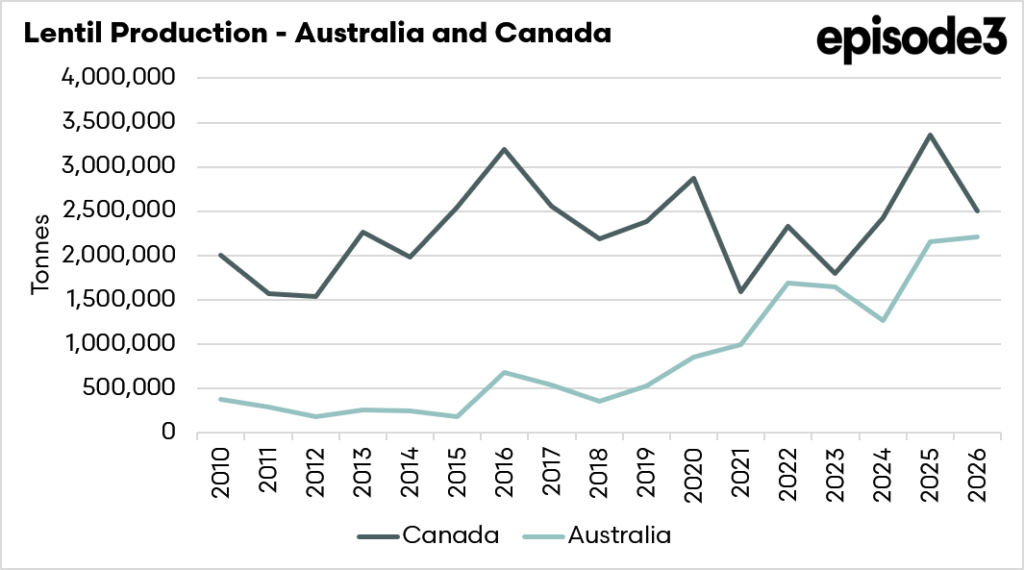
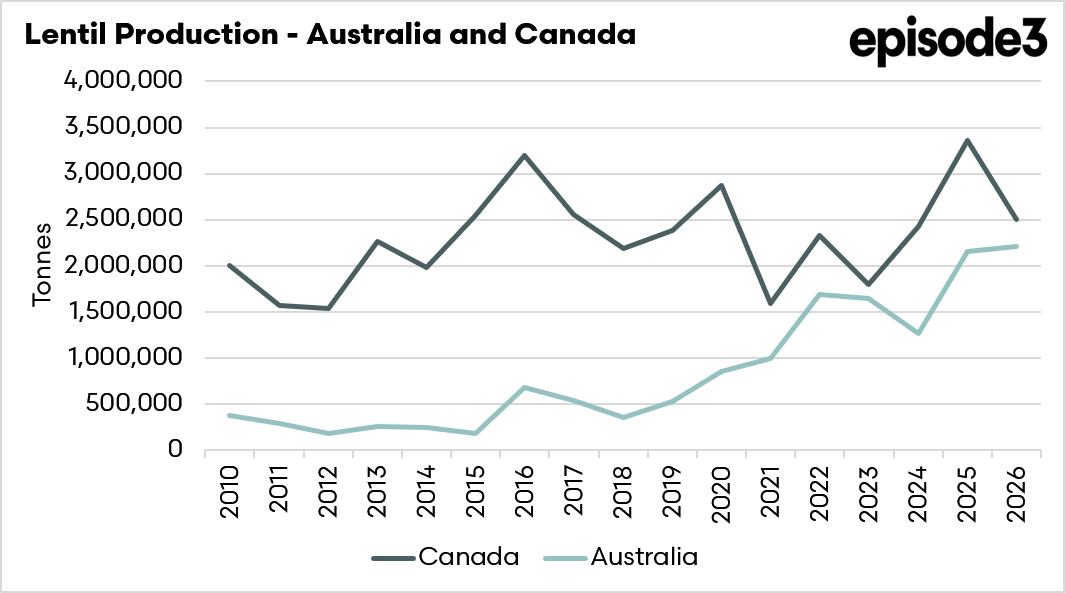
Australian lentil production is heading for another record, with the 2026 crop forecast at around 2.21 million tonnes. That is an impressive number on its own, but the more interesting story is how rapidly Australia’s position in the global lentil market has changed. In 2010, Australia produced just 380,000 tonnes compared with a Canadian crop of just over 2 million tonnes. Sixteen years later, Canada is forecast to produce 2.5 million tonnes and Australia 2.21 million tonnes. We have gone from being a relatively small player to almost matching the country that has traditionally dominated global lentil exports.
The growth has been extraordinary. Between 2010 and 2026, Australian lentil production has increased by around 482pc, while Canadian production has increased by about 25pc over the same period. In 2010, Australia’s crop was equivalent to only 19pc of Canada’s production. This year it is forecast to be equivalent to around 88pc. Put another way, Australia accounted for just 15.9pc of combined Australian and Canadian production in 2010, but that share has now risen to 46.9pc.
That is more than just a good production story. It is a fundamental change in Australia’s importance to the global lentil market. We are no longer a smaller supplier taking whatever price is established by the major players elsewhere. Australian production is now large enough that what happens in our paddocks can meaningfully influence global supply, and that means our own production growth can eventually work against us if demand fails to keep pace.
Lentils are not wheat
This matters because lentils work in a very different market to wheat or barley. If Australia produces another million tonnes of wheat, those tonnes enter a global market measured in hundreds of millions of tonnes. It may affect regional prices and export competition, but adding a million tonnes is still relatively small compared with the total amount of wheat produced and traded worldwide; even in a major drought, Australia has minimal impact on global pricing.
An additional million tonnes of lentils is much harder for the market to ignore. Australia and Canada are forecast to produce a combined 4.71 million tonnes in 2026, the second-highest combined production in the data since 2010, behind only the 5.51 million tonnes produced last year. With production concentrated among relatively few major exporters, changes in Australian and Canadian crops can have an outsized impact on the volume of lentils looking for a home.
Demand is concentrated as well. A relatively small group of major importing markets, particularly India, Türkiye, and countries across the Middle East and South Asia, has significant influence over international trade. That means changes in domestic production, import policy or buying behaviour in one major destination can have a much larger effect than they would in more diversified commodity markets.
A good crop can still make sense
None of this means lentils have suddenly become a bad crop to grow. They have become increasingly important across farming systems in South Australia and Victoria for good reasons; they have paid off many farms in South Australia!
Lentils can provide valuable rotational diversity, fix nitrogen and contribute benefits to the broader farming system that are not always captured by looking solely at the price received for the crop.
Episode 3 had already discussed the risk of oversupply earlier in the year (See here). That distinction becomes increasingly important as Australian production grows, because agronomic value and commodity-market value are not necessarily the same thing.
Agricultural markets also have an annoying habit of eventually responding to their own success. Farmers, when they get on a good thing, go all in. Attractive returns encourage growers to plant more area, production rises, and eventually the additional supply starts competing for a finite amount of demand. That does not mean prices have to collapse, but it does mean growers should be cautious about assuming that the returns which encouraged the expansion of lentils will automatically continue as production moves to a permanently higher level.
The challenge has changed
For much of the past decade, Australia’s lentil story has been about producing more. We have become very good at that. Production has risen from less than 400,000 tonnes in 2010 to more than 2.2 million tonnes today, and Australia has gone from producing less than one-fifth of Canada’s crop to almost matching it tonne for tonne.
The next challenge is making sure demand develops alongside that production. That means Australian growers need to pay more attention to Canadian production and stocks, crops in major consuming countries, import policy and the pace at which buyers are taking tonnes. Marketing becomes increasingly important when your own country is large enough to move the market.
A 2.21 million tonne Australian lentil crop is an extraordinary achievement and another sign of how rapidly Australian cropping systems continue to evolve.
We need to make sure we don’t kill the golden goose.