
Global cattle pricing update September 2026

Get short video updates on your phone
For quicker updates as markets move, follow @themeatwatcher on Instagram. I regularly post short summaries and charts breaking down what’s happening in meat proteins and broader ag markets so you can stay across the key moves without having to read through pages of analysis. If markets are moving quickly, that’s usually where the updates will land first.
Global cattle price update - August 2026
Global cattle prices moved in different directions throughout September, with Australia and Brazil firming while the US and Argentina eased. The latest EP3 global cattle price update shows Australian heavy steer values rising from 430Ac/kg lwt in August to 448Ac/kg lwt in September. That was a 4.2pc increase over the month. The move has pushed Australia back above Argentina and has narrowed the gap to the US. However, Australia remains well above Brazil, which continues to be the low-cost benchmark in global cattle price comparisons.
The US recorded the sharpest monthly fall of the four markets. US heavy steer prices eased from 709Ac/kg lwt in August to 681Ac/kg lwt in September. That was a 3.9pc monthly decline. Even after that fall, the US remains the most expensive cattle market in the comparison by a considerable margin. Australian heavy steer prices are still 34pc below the US. That is a large discount, but it is a much narrower gap than the one evident earlier in the year, when US cattle values were approaching 800Ac/kg lwt.
The US price decline is worth watching closely. US cattle supplies remain tight, and the broader herd-rebuilding story has not suddenly been solved. However, the easing in prices suggests that the news of Trump’s quota suspension of 300,000 tonnes of US beef imports has taken some heat out of the US market. That matters for Australia because the wide gap to the US has been a key support for the competitiveness of Australian beef in premium export markets. When US cattle are extremely expensive, US beef becomes harder to price into markets such as Japan, South Korea and parts of North Asia. That gives Australian product more room to move. If US cattle prices continue to ease, some of that advantage may narrow. For now, though, the US remains expensive enough that Australian beef retains a meaningful price advantage over its main grain-fed competitor.
Argentina also eased through September. Argentine heavy steer prices moved from 449Ac/kg lwt in August to 438Ac/kg lwt in September. That was a 2.6pc fall across the month. The move has taken Argentina back below Australia. Australian heavy steer prices are now 2pc above Argentina.
That is not a large premium, but it does represent a shift from earlier months, when Argentina was just ahead of Australia. The comparison between Australia and Argentina remains close. Both markets are now sitting in the mid 400Ac/kg lwt range. That suggests the two are much more closely aligned than either is to the US or Brazil. Argentina remains a market to watch because it can be a strong global beef competitor when policy settings, currency movements and export conditions line up.
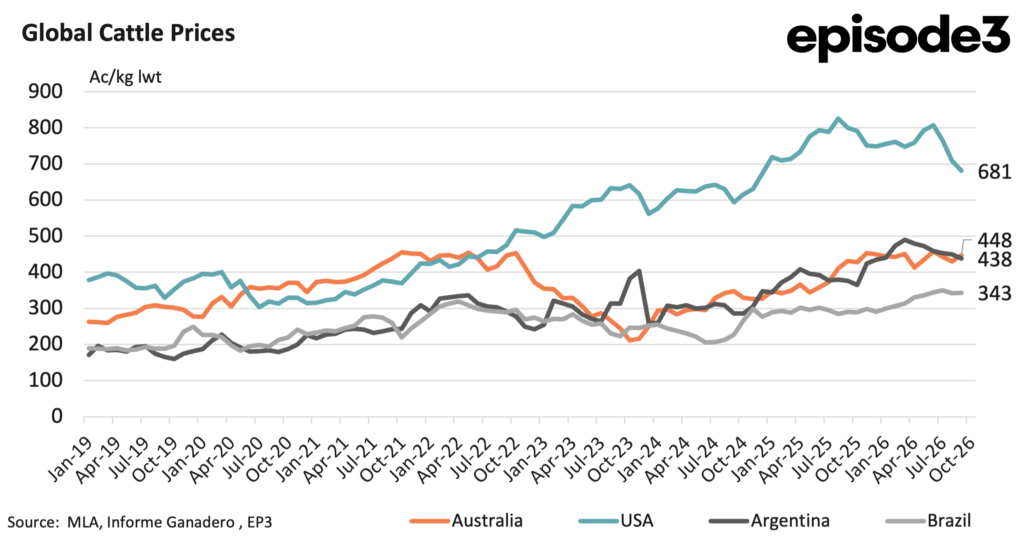
Brazil was steady to slightly firmer. Brazilian heavy steer prices lifted from 342Ac/kg lwt in August to 343Ac/kg lwt in September. That was only a 0.2pc increase, so the broad story is one of stability rather than a meaningful rally. Brazil remains the cheapest market in the comparison. Australian heavy steer prices are currently 30pc above Brazil.
That premium matters. It highlights Brazil’s ongoing cost advantage in price-sensitive beef markets, particularly where buyers are more focused on price than on brand, provenance or specification. Australia cannot ignore that gap.b It may be cheaper than the US, but it remains expensive compared to Brazil.
That leaves Australia in the middle of the global cattle price pack. It is well below the US, now just above Argentina, and well above Brazil. The September update is therefore a mixed but generally supportive one for Australia. Local heavy steer prices have improved, which is positive for producers. At the same time, the US has eased, which slightly reduces the international price gap that has helped Australian beef competitiveness.