
Spring flow cools young cattle
Market Morsel
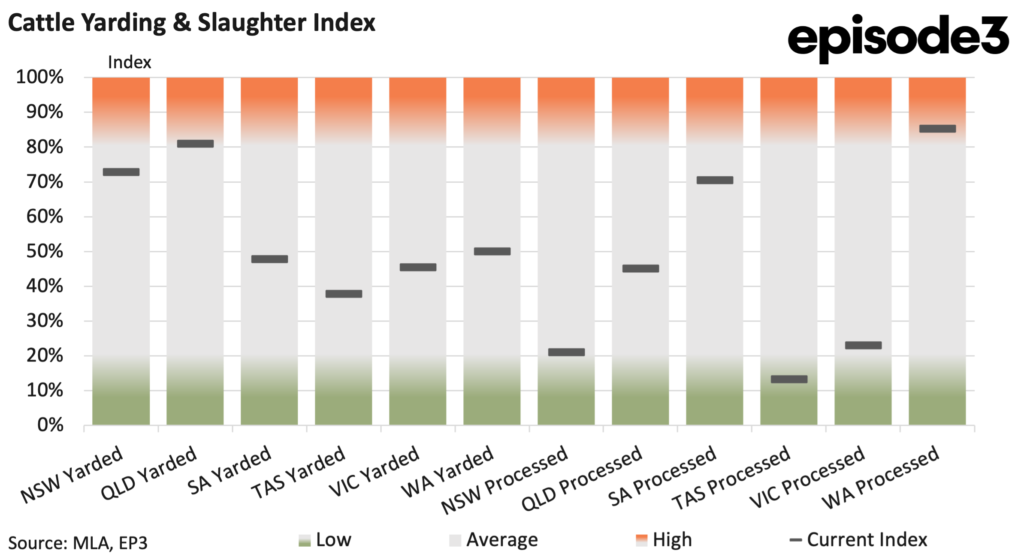
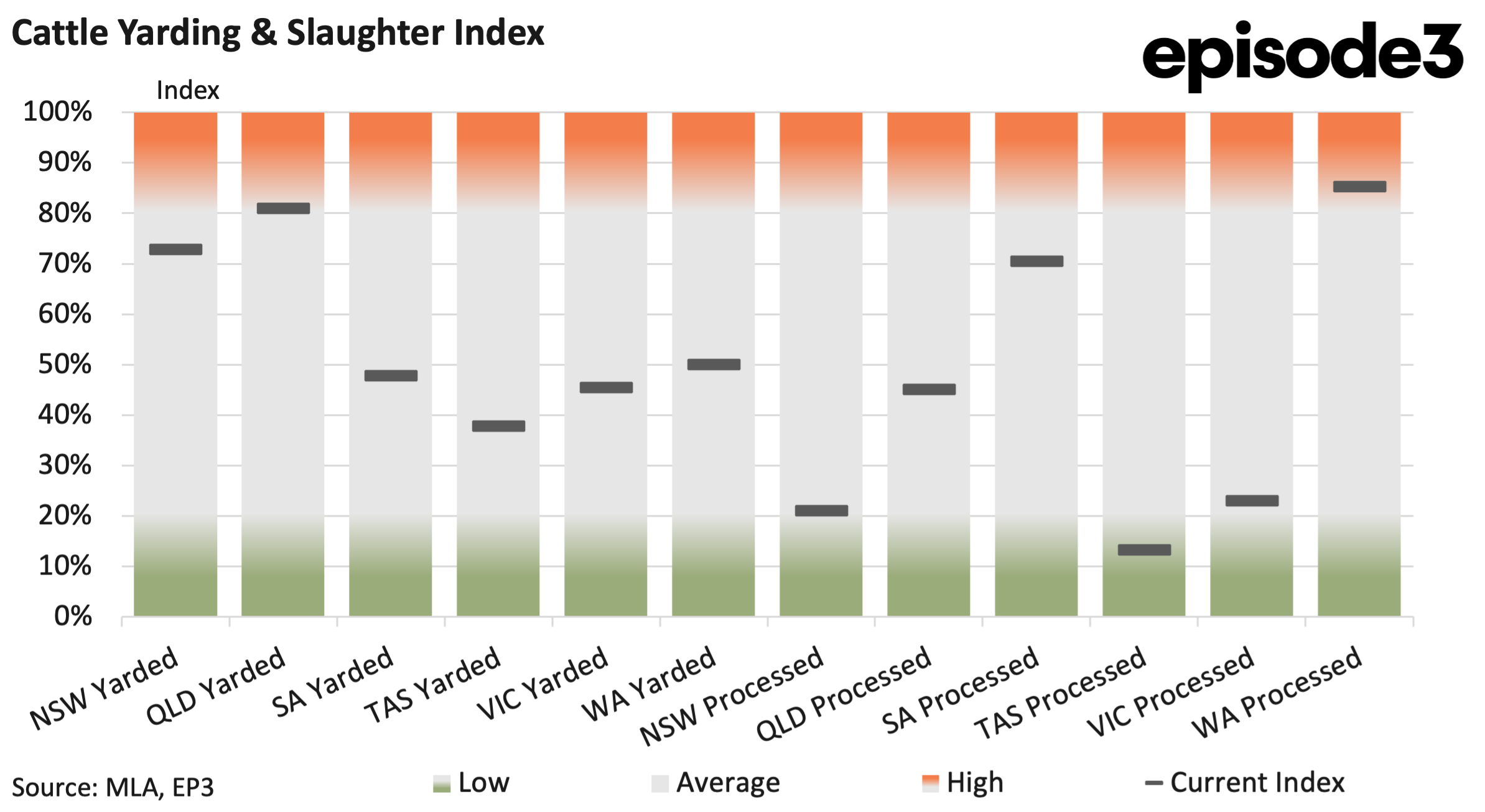
The latest Cattle Yarding and Slaughter Index shows the Australian cattle market moving decisively out of its winter supply squeeze, with cattle yardings lifting across every state during September while processing activity generally moved in the opposite direction. The change is particularly noticeable across the eastern states, where August had been characterised by tight cattle availability and processors competing harder to secure numbers.
New South Wales recorded the largest increase in yardings, with its index jumping from 47pc in August to 73pc in September. Queensland yardings also strengthened considerably, rising from 68pc to 81pc. Victoria increased from just 26pc to 45pc, while South Australia lifted from 30pc to 48pc. Tasmania moved from 30pc to 38pc and Western Australia increased from 37pc to 50pc.
The consistency of the movement is important, as every state recorded an increase in cattle coming through saleyards during September. Part of this reflects the normal transition from winter into spring, but seasonal conditions are also beginning to influence producer selling decisions. Drier conditions across parts of Queensland and New South Wales have encouraged more cattle to come forward, adding to the normal seasonal increase in availability.
The processing side of the CSYI tells almost the opposite story. New South Wales slaughter activity dropped from 39pc to 21pc despite the substantial increase in yardings. Queensland processing eased from 53pc to 45pc, while South Australia declined from 79pc to 70pc. Tasmania dropped from 28pc to just 13pc and Victoria fell sharply from 46pc to 23pc. Western Australia was the only state to move against the trend, with processing activity increasing from 69pc to 85pc.
This creates a significant disconnect between the two sides of the index. More cattle are appearing through saleyards, but eastern processors have not yet responded by increasing slaughter activity. That is a considerable change from August, when tight availability was forcing processors to compete for cattle despite challenging export meat margins. September suggests the balance has begun shifting back towards buyers as the number of cattle available for purchase increases.
The latest cattle price movements support that interpretation, although there is an important difference between young cattle and slaughter-ready stock. Over the past four weeks, feeder steer prices have declined by 32/kg liveweight, while feeder heifers have fallen 33c/kg. Restocker yearling steers have eased by 10c/kg, while restocker yearling heifers recorded the largest correction, falling 45c/kg. These are substantial moves and represent a sharp reversal from August, when restocker and feeder categories were among the strongest-performing parts of the cattle market.
The combination of higher yardings and softer restocker values suggests the supply equation has changed rapidly. More young cattle are coming forward at the same time as buyers have become increasingly cautious about paying the prices evident during the winter supply squeeze. Dry conditions in parts of Queensland and NSW may also be contributing to this dynamic by reducing the incentive to retain lighter cattle for additional weight. Slaughter-ready cattle have been considerably more resilient. Processor cow prices eased by 15c/kg liveweight over the past four weeks, while heavy steer prices have been steady.
That divergence is significant. It suggests the increase in overall cattle availability has not yet translated into an equivalent increase in finished cattle suitable for immediate slaughter. Processors may have more cattle appearing in front of them, but that does not necessarily mean they have an abundance of the specifications required to keep processing chains operating efficiently.
The slaughter index reinforces this point. Processing activity remained relatively subdued across most eastern states during September as the industry continued working its way out of the winter supply lull. The increase in saleyard cattle appears to be occurring ahead of a broader recovery in processor throughput. This helps explain why heavy steer values have remained supported while young cattle prices have fallen considerably. Buyer requirements are also diverging. Processors remain interested in suitable finished cattle and specific grainfed specifications, while feeder and restocker buyers have become more selective as greater numbers become available. The result is no longer one cattle market moving in a common direction.
September has produced a clear separation between categories. Young cattle have borne much of the price pressure from improving supply, while slaughter cattle have proven considerably more resistant. There are some early signs that the young cattle correction may be stabilising. Restocker yearling steer and heifer indicators strengthened during the most recent week despite remaining substantially lower over the four-week period. That suggests the sharp September adjustment may have already attracted some buyers back into the market.