
Farmland values keep climbing

Market Morsel
Australian farmland values have continued their remarkable upward trajectory, with the national median price reaching a new high of $10,516 per hectare in 2025. However, while land values have continued to climb, the number of properties changing hands has been heading in the opposite direction. The divergence between prices and transaction volumes raises an interesting question about the strength and depth of the Australian farmland market.
The longer-term trend in farmland values has been extraordinary. Back in 1995, the median Australian farmland price was closer to $1,100 per hectare. Thirty years later, that figure has increased almost nine and a half times. While consolidation has occurred at times, the broader trend has been overwhelmingly positive, particularly over the past decade.
Between 1995 and 2005, farmland values more than doubled to $2,650 per hectare before entering a relatively subdued period. From 2007 through to 2014, prices largely moved sideways, fluctuating around $3,000 to $3,500 per hectare. This period marked a breather after the strong appreciation of the early 2000s. However, from around 2015, the market began another sustained upward movement, accelerating dramatically after 2020. Between 2020 and 2025, median farmland values rose from $6,000 to over $10,500 per hectare, a gain of about 75pc in five years. The largest annual increase occurred in 2022, when values surged by 27pc, following an already impressive 19pc increase during 2021.
Historically low interest rates, strong agricultural commodity prices, favourable seasonal conditions, and demand for farmland as a long-term investment helped drive this extraordinary period of appreciation. Established farming businesses looking to expand were competing for land alongside investors seeking exposure to agricultural assets. More recently, the pace of growth has moderated considerably. Median values rose 6.1pc in 2023, 5.7pc in 2024, and just 3.1pc in 2025. Farmland is still appreciating, but the extraordinary growth rates experienced earlier in the decade appear to have given way to a more measured market.
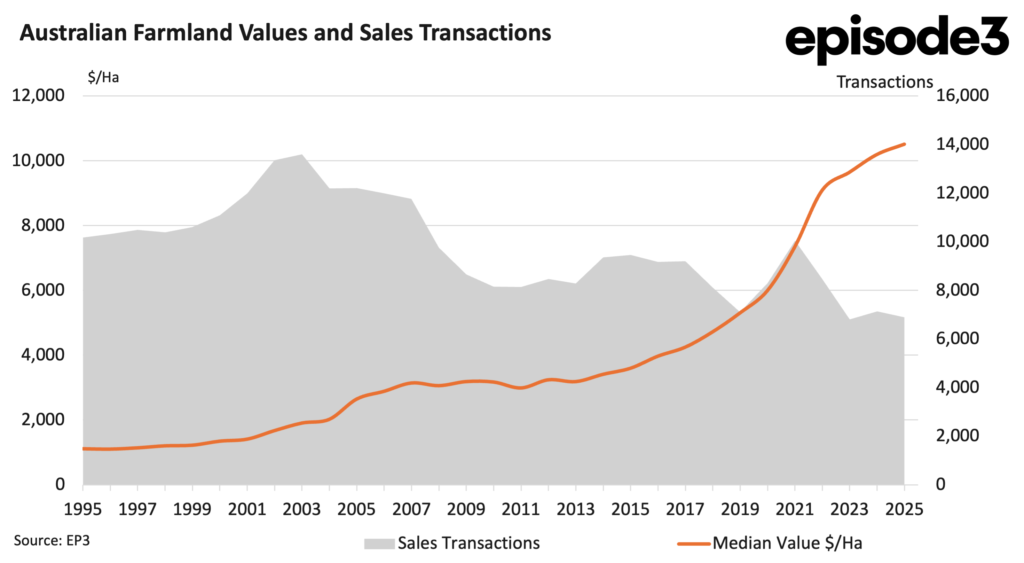
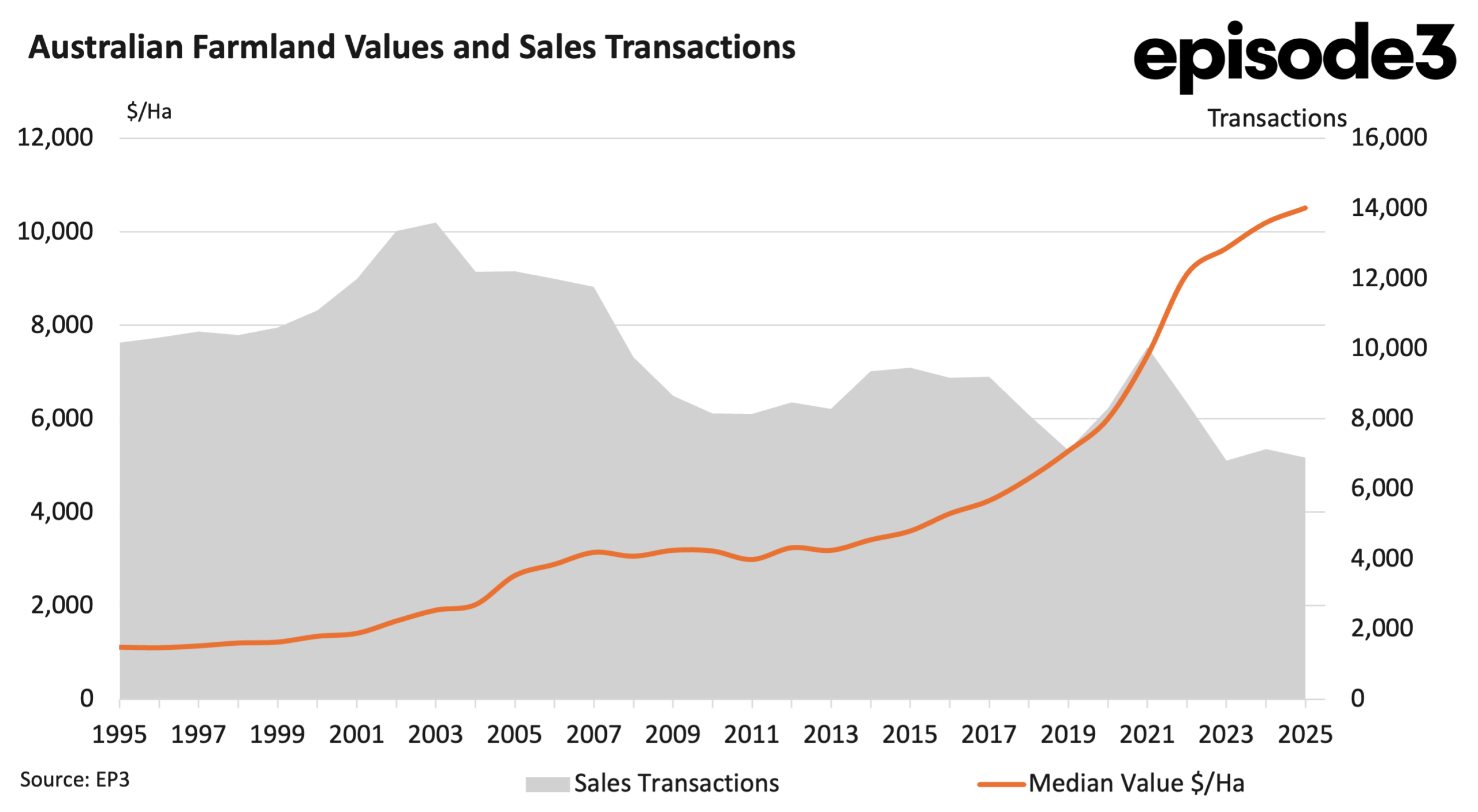
Perhaps the more interesting trend is what has happened to sales transactions. During the early 2000s, farmland sales were relatively frequent, peaking at approximately 13,600 transactions in 2003. Since then, the number of properties changing hands has generally declined, albeit with several temporary recoveries. By 2025, annual transactions had fallen to about 6,900, nearly half the activity recorded at the 2003 peak. Market activity briefly surged in 2020 and 2021, when transactions rose to around 8,300 and 10,000, respectively. However, this recovery proved short-lived, with volumes falling sharply in subsequent years. Transactions declined to approximately 6,800 in 2023, recovered marginally during 2024 and slipped back to 6,900 in 2025. This creates an interesting dynamic. Farmland values are sitting at record levels, yet the number of properties available and changing hands remains relatively subdued.
Part of the explanation may be that existing landholders are increasingly reluctant to sell. Strong balance sheets, opportunities for business expansion and the long-term appeal of owning productive agricultural land can encourage owners to retain their holdings. Meanwhile, succession planning and corporate ownership structures may also be contributing to longer holding periods. Importantly, lower transaction volumes can also affect how representative the median price becomes. When fewer properties are sold, changes in the mix of farms transacted, including location, size and productive capacity, can influence the national median. Higher prices therefore do not necessarily mean every farming district or property type is experiencing the same level of appreciation.
The broader message is that Australian farmland remains a highly valued asset, but the market is becoming increasingly thinly traded. With fewer transactions, buyers may have fewer opportunities to secure suitable properties, while vendors of quality farmland may continue to command considerable premiums. The real test will be whether agricultural profitability weakens or borrowing costs remain elevated. Record land values have been maintained despite falling sales activity, but whether that appreciation can continue without a recovery in market liquidity remains an important question for the years ahead.