
Wool Market Update – The Big Short

The Big Short, And Why It Matters To Your Wool Cheque
I watched the movie The Big Short again recently. It’s the lead up to the GFC, told through the few people who saw it coming.
Michael Burry and Mark Baum (Steve Eisman in real life) simply read the data everyone else had and believed it: people couldn’t
meet their mortgage payments, yet banks were bundling those loans into CDOs and selling them as safe. A CDO, a collateralised
debt obligation, is a bundle of loans sold to investors as one product, paid out of the borrowers’ repayments. When the
repayments stopped, the CDOs collapsed and took the banks with them. They never really went away either: by 2015 banks were
selling them again as the bespoke tranche opportunity.
You may be asking what this has to do with the wool market? Quite a lot. Wool is a luxury. Yes, we have come a long way and you
can pick up a pretty cheap shirt or jumper nowadays, but it is still not a necessity. When the CDOs blew up, credit froze and the
confident shopper disappeared. The EMI fell 49 percent in US dollars between February 2008 and February 2009, and 29 percent
for Australian growers because our dollar fell from 95 US cents to 61. Then the world printed money to fix it. China’s share went
into building and factories, its mills went shopping, and the EMI almost doubled, up 93 percent in Australian dollars by June 2011.
Where The Printed Money Went
You can’t print that much money and have no effect. It has to show up somewhere, and the last 17 years have taught one simple
rule. Money that goes to the banks shows up in houses and shares: after the GFC the US Federal Reserve’s balance sheet grew
fivefold and shares more than doubled, while consumer prices rose just 1.6 percent a year. Money that goes into people’s pockets
shows up at the checkout: COVID cheques pushed US inflation to 9.1 percent, and in Australia A$281 billion of Reserve Bank bond
buying took house prices up 30 percent and inflation to 7.8 percent.
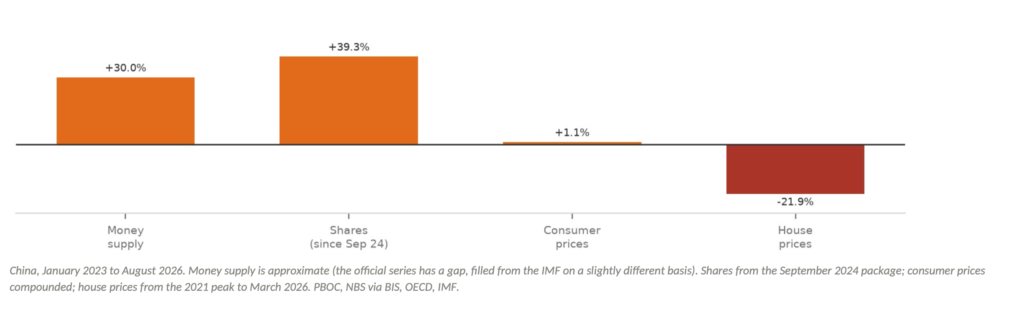
China is the one that matters most for wool, because it takes 88 percent of ours. It has thrown stimulus at its economy again and
again, most recently on 29 September, and its money supply is about ten times what it was in 2007. Yet prices have barely moved,
averaging 0.3 percent inflation since January 2023, and house prices are down 22 percent. The property bust is soaking the money
up. In 2009 China’s money reached its people and wool almost doubled. This time it hasn’t.
And in Australia, the Reserve Bank has lifted the cash rate four times this year to 4.60 percent, with inflation still at 4.0 percent.
House prices hit a new high in March, but rates take three to four quarters to bite, so the next twelve months is when we find out.
For a grower it means the overdraft and carrying wool both cost more.
So What Does This Mean For The Wool Market Right Now?
All of that is the big picture. What I want to know, and I’d want to know if I was growing wool, is what it means for the market.
Some of it is working for you and some of it is working against you.
Working for you
China’s stimulus is finally starting to show at the edges. Chinese inflation has been back above zero all year, between 0.8 and 1.3
percent since February, after two years of flirting with deflation. Chinese shares are up 39 percent since the September 2024
package. And on 29 September Beijing added a mortgage interest subsidy for first-home buyers. If that steadies Chinese housing,
that’s the household confidence a wool jumper needs.
The factories are busy. The September factory surveys had China at 52.1, the US at 54.5, Japan at 54.1 and Italy back above 50 at
50.4. Anything over 50 is a sector growing, and growing mills order wool.
And the money taps are open again. The US Federal Reserve stopped shrinking its balance sheet in December 2025 and it has
grown by about US$200 billion since. Money looking for a home tends to lift commodities along with everything else. You can see
it in the price: the EMI is 1,803 cents against 1,456 this time last year, up 24 percent.
Working against you
The Chinese shopper still isn’t buying clothes, and that matters more than people think: about half of what China makes from wool
is worn in China, not exported. Chinese clothing sales were down 0.5 percent in August. Beijing’s money is going into property,
technology and trade-in subsidies for cars and appliances, not into the wardrobe.
Money is dearer in Australia. Four rate rises this year make it cost more to carry wool and run the overdraft, and the US is still
holding its own rate at 3.75 percent with inflation of 3.4 percent.
On top of that the season has given us a broader clip, so 20 and 21 micron fell 8 to 10 percent over the last six weeks while 17
micron held and 19 micron eased 3 percent.
Put it together and I read this as a market with real support underneath it, but without a strong push from the buyer that matters
most, the Chinese shopper. That’s still why I’d be patient into the January lift rather than chasing the market down now.
The mills have said it themselves: September through to December is when they forward sell product, generate business and get
an idea of what their own clients want to spend and order. So when I read a headline from a WA publisher this month, “Chinese
wool processors all talk, no action?”, it frustrated me. Again, people are just looking at the EMI, which is bad enough, but it’s even
worse looking at the market week to week and not the big picture. Week to week it can look like nothing’s happening. Over the
season, this is when the groundwork for the new-year buying gets laid.
Where The Market Needs To Be, And What It Costs To Wait
Here’s where it all comes back to your income. Printing money lifts prices, but it lifts a farmer’s costs faster than it lifts what the
farmer gets paid. So I measured what a kilo of wool actually buys in farm inputs, against what growers pay for fuel, fertiliser,
chemicals, labour and the rest, from ABARES.
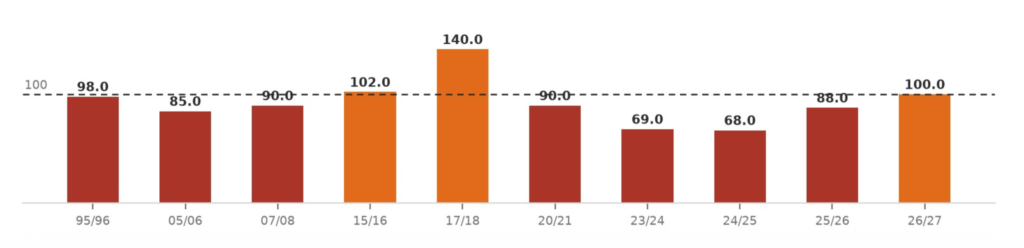
At the 2017/18 record a kilo of wool bought 40 percent more than it does today. The rally since the 2024/25 low has got us back
to about where we were 30 years ago, which is a recovery, not a good result. To buy what it bought at the record, the EMI needs
to be 2,586 cents against 1,803 today. The EMI is a weighted average of every micron sold, so I’ve taken each micron’s spread to
the EMI this season, weighted by the bales sold each month, and applied it to that 2,586.


The cost of holding
Waiting for the market isn’t free. The money your wool would make sitting in the bank is given up, at the Reserve Bank’s 4.60
percent, and after six months free in store the bales cost approximately 15 cents a bale a day. Here’s what that adds up to. A 50
bale clip is roughly 35 bales of fleece and the rest skirtings and oddments; every bale is held, valued at today’s EMI on an average
bale of 180 kg greasy at a 63.3 percent yield.


The dollars grow with the clip, but the lift the market needs to cover them doesn’t. Whether you hold 50 bales or 500, this is how
far your micron has to rise just to break even:


Put the two tables side by side and that’s the whole story. Holding into January costs a bit over 1 percent. The market needs to lift
40 to 50 percent just to give wool the buying power it had at the record. A good January won’t close that gap on its own but
looking the data and understanding where the market is and why, can help close the gap. Pay attention to marketing your wool
and what’s driving or holding back prices. If you struggle with the time to deep dive into the macroeconomics, this is where an
independent advisor comes in. it could be the difference between “just selling” and closing the gap.
What To Keep An Eye On
The Reserve Bank meets again on 3 November. Another rise would be the fifth this year, and the housing lag says the first four
haven’t fully landed yet. China’s October inflation and retail figures in early November. A real pick-up in the Chinese consumer would be the best news
wool could get, and so far the stimulus hasn’t delivered it. The factory surveys on 1 November, and Ifo at the end of the month. They lead wool more reliably than the shops do. 21 micron at $18.36 a kilo clean on 15 October, just under its 1 October low of $18.37. Chinese New Year falls on 6 February and
I’ll go through it properly in the November report.